
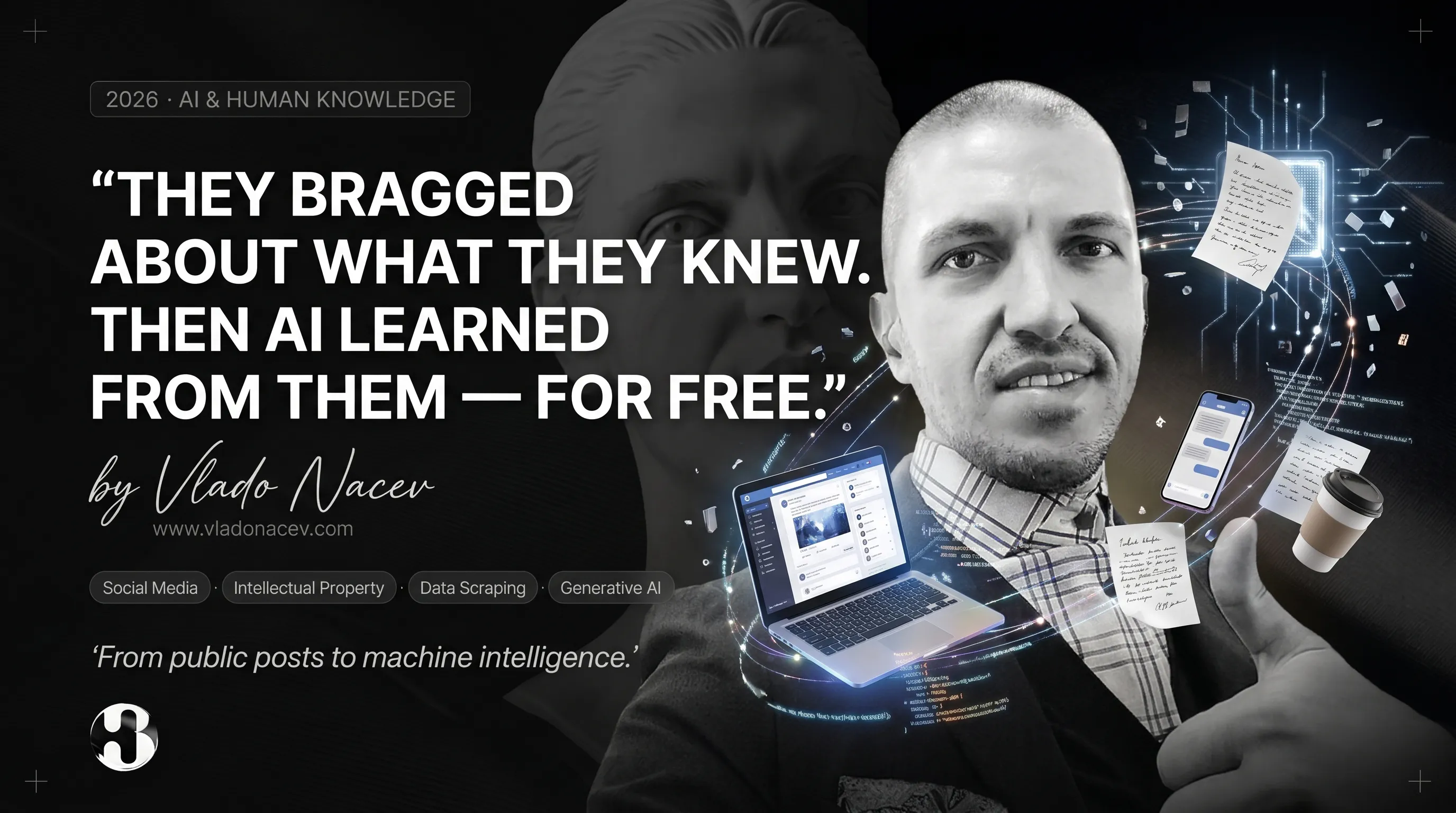

They Bragged About What They Knew. Then AI Learned From Them — For Free.
Tags · Artificial Intelligence · Machine Learning · Technology · Content Creation · Future of Work · Personal Brand · Madebyvladonacev
Author · Vlado Nacev
How professional social networks turned human expertise into a massive training resource for artificial intelligence — and why the people sharing their knowledge don't necessarily get a share of the value it creates.
First, they built the platforms.
LinkedIn, X, Medium, and every other digital stage where you can give yourself a 15-word job title, add Expert, Strategist, Thought Leader, AI Specialist, and three more acronyms nobody has ever heard of but that sound sufficiently authoritative.
Then the show began.

One person explained how SEO works. Another revealed the secrets of marketing. Someone else shared their architecture for scalable systems. A fourth published code that was supposedly going to change the industry.
Every day. A new post. A new strategy. A new revelation.
"Here's how I do it."
"Five things I learned in 10 years."
"Most people don't understand this."
"Here's why 99% of designers get it wrong."
And, of course, the obligatory:
"Agree? Let's discuss in the comments."
Everyone wanted to prove how much they knew. Build a personal brand. Attract clients. Become recognizable in their industry.
And then something interesting happened.

The Audience Changed. The Platform Stayed the Same
Public articles. Discussions. Code examples. Technical explanations. Tutorials. Analyses. Answers to questions.
In other words, a substantial amount of what professionals voluntarily shared to build their own reputations was sitting right there, in places where machines could potentially access it.
Public online content is one of the sources used to train modern AI models. Companies also use licensed datasets, partnerships, and other sources of information.
And here comes the irony.
A person publishes for free to prove they know what they're talking about.
A machine processes information to learn how to explain things.
Then someone asks AI how to do something that previously required finding that exact specialist, reading their articles, or paying them for a consultation.
Sometimes, the answer arrives in seconds.

The Biggest Free Course in History?
Thousands of designers published their thinking on composition, typography, color, and UX.
Developers shared code, architectural decisions, debugging techniques, and technical discussions.
SEO specialists published analyses, strategies, experiments, and interpretations of search algorithms.
Marketers revealed how they built campaigns, positioned products, and understood consumer behavior.
Everyone left something of their professional experience on the internet.
Not necessarily their entire know-how. Not every post ended up in a training dataset. But at the scale of the public web, an enormous amount of human knowledge accumulated — knowledge that can be used to develop AI systems.
And while people collected likes, comments, and followers, the industry was building tools capable of synthesizing knowledge from multiple sources and making it available to anyone with an internet connection.
The expert publishes the knowledge. The platform distributes it. The AI industry builds a product on top of the information. And the author doesn't necessarily receive direct compensation for that use.
That's the economic paradox.

"But I Chose to Publish It."
And that's the strongest argument on the other side.
When you publish something publicly on the internet, you cannot assume it will remain accessible only to the people you want to impress.
But there's a difference between someone reading your article, learning from it, quoting it, or sharing a link to it — and your content becoming part of an industrial process used to develop a commercial product.
Public accessibility does not automatically mean every possible use is authorized. Questions surrounding copyright, consent, licensing, and compensation remain the subject of serious legal and public debate.
There's another issue, too.
Many people published their knowledge years before generative AI became mainstream. They did it to develop their careers, contribute to their communities, or attract clients — not necessarily because they imagined their posts might one day help train a system capable of providing similar expertise at massive scale.
That doesn't automatically mean the use is illegal. It means technology has changed the economic significance of an apparently simple action: sharing something publicly.

The Irony of the Personal Brand
Share your knowledge.
Build authority.
Show your process.
Don't keep everything to yourself.
Create content.
Be useful.
And people did exactly that.
Professional platforms became enormous libraries of personal experience, expert opinions, practical solutions, and technical knowledge.
Then AI arrived, capable of summarizing, combining, and applying some of what it learned from materials like these.
Suddenly, an uncomfortable question emerged:
If you've spent ten years building expertise, and a machine can use an enormous body of human knowledge to deliver part of that expertise almost for free, what exactly is the value of what you've published?
The answer isn't that experts are no longer valuable.
But the value is shifting.
Information itself is becoming more accessible. The ability to verify that information, distinguish what's correct from what merely sounds convincing, take responsibility for decisions, and create something that actually works is becoming even more important.
AI can explain how to build a system.
That doesn't mean it can automatically take responsibility for a real system running in production.
It can generate code. That doesn't mean it understands every consequence of deploying it.
It can give you an SEO strategy. That doesn't mean it will be accountable for your business results.
The difference between information and expertise has never mattered more.

So, Who Actually Won?
AI companies gained access to enormous amounts of information, including through public sources and licensed datasets.
Users gained a new way to search for, summarize, and apply knowledge.
And the creators?
Some gained audiences, clients, and opportunities. Others gained a little more visibility. A third group may find parts of their work reproduced or used in contexts they never imagined.
There isn't one answer for everyone.
But the question of who creates value and who receives the economic benefits remains entirely legitimate. The debate over creators' consent and compensation has become a central part of the discussion around AI training.
And perhaps the most ironic part is this:
While some people were trying to prove on LinkedIn that they were among the best professionals in the world, they kept publishing evidence of how they think, how they work, and how they solve problems.
Not all of those posts were used to train AI. Not every system was trained in the same way. But the direction is clear: human knowledge has become one of the most valuable resources in the AI economy.

And the biggest paradox?
Voluntarily.
Post by post.
Comment by comment.
Without receiving separate compensation for every potential use of the content they published.

The Final Thought
The problem is that the internet taught us to treat knowledge as content, content as a means of gaining attention, and attention as currency.
Now AI adds another layer: knowledge can be processed at a scale no individual specialist could ever achieve alone.
And while we argue about whether machines will replace professionals, perhaps we should ask another question:
When human expertise becomes a raw material for an entirely new industry, who should receive the value it creates?
Especially when the people who helped make that raw material available didn't even know what was coming.
And now imagine how many of those people will publish another post tomorrow about how AI is changing the world.

Connect With Me
You can reach out or collaborate with me through:
Or just drop a line through my Contact Page.
Design, development, brand, ui/ux and blog — Madebyvladonacev
📍 Tags

Related Work
Explore projects that share the spirit and approach of this article.
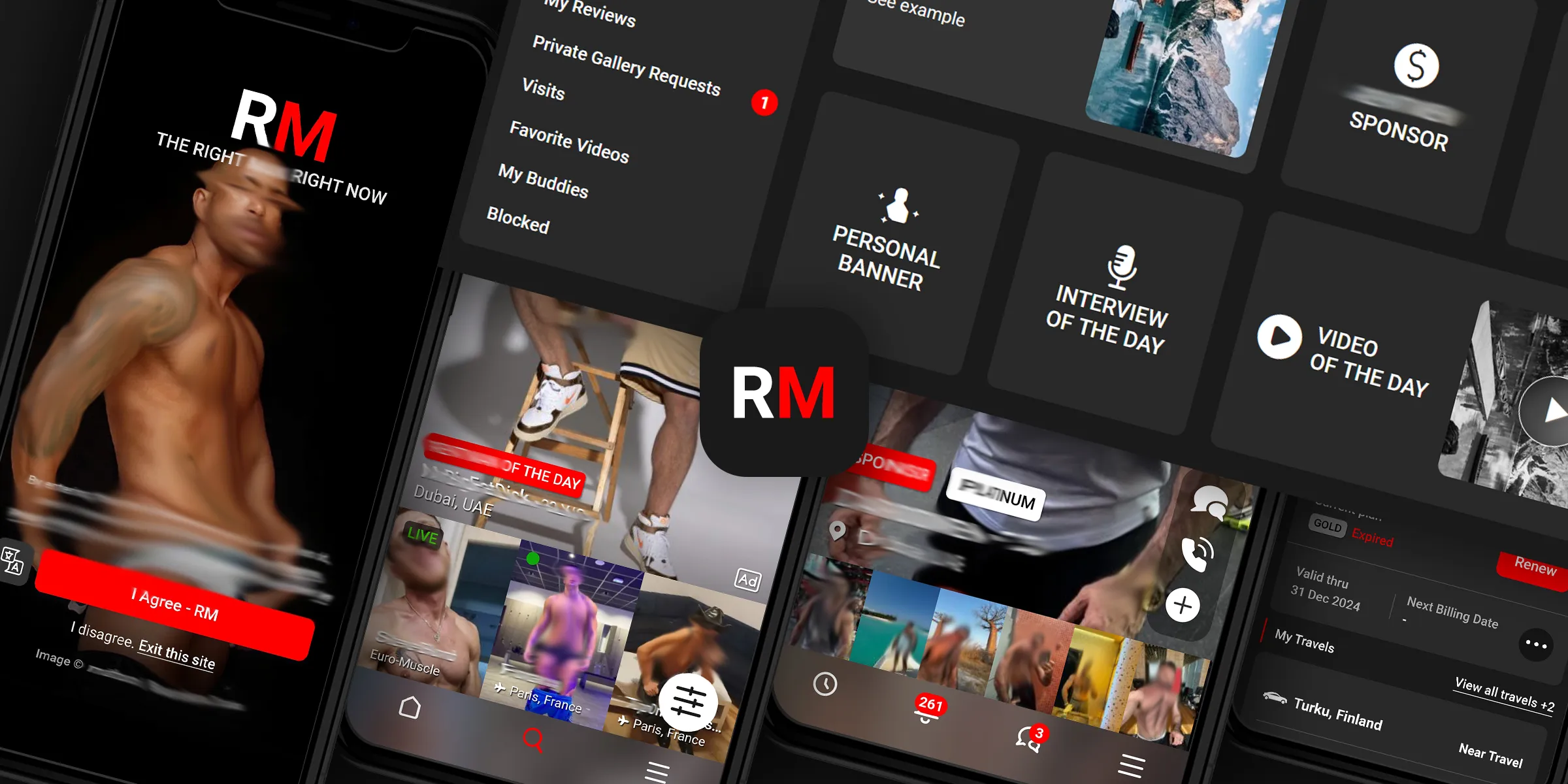
RM Platform Redesign
Browse · Web Design
Software · Figma · Photoshop · Illustrator · Gitlab, PhpStorm.
Technologies · Web Design · UX/UI Design · Web Application · React · Next.js · Bulma CSS Framework · HTML5 · CSS3 · SaaS · Responsive Web Design.
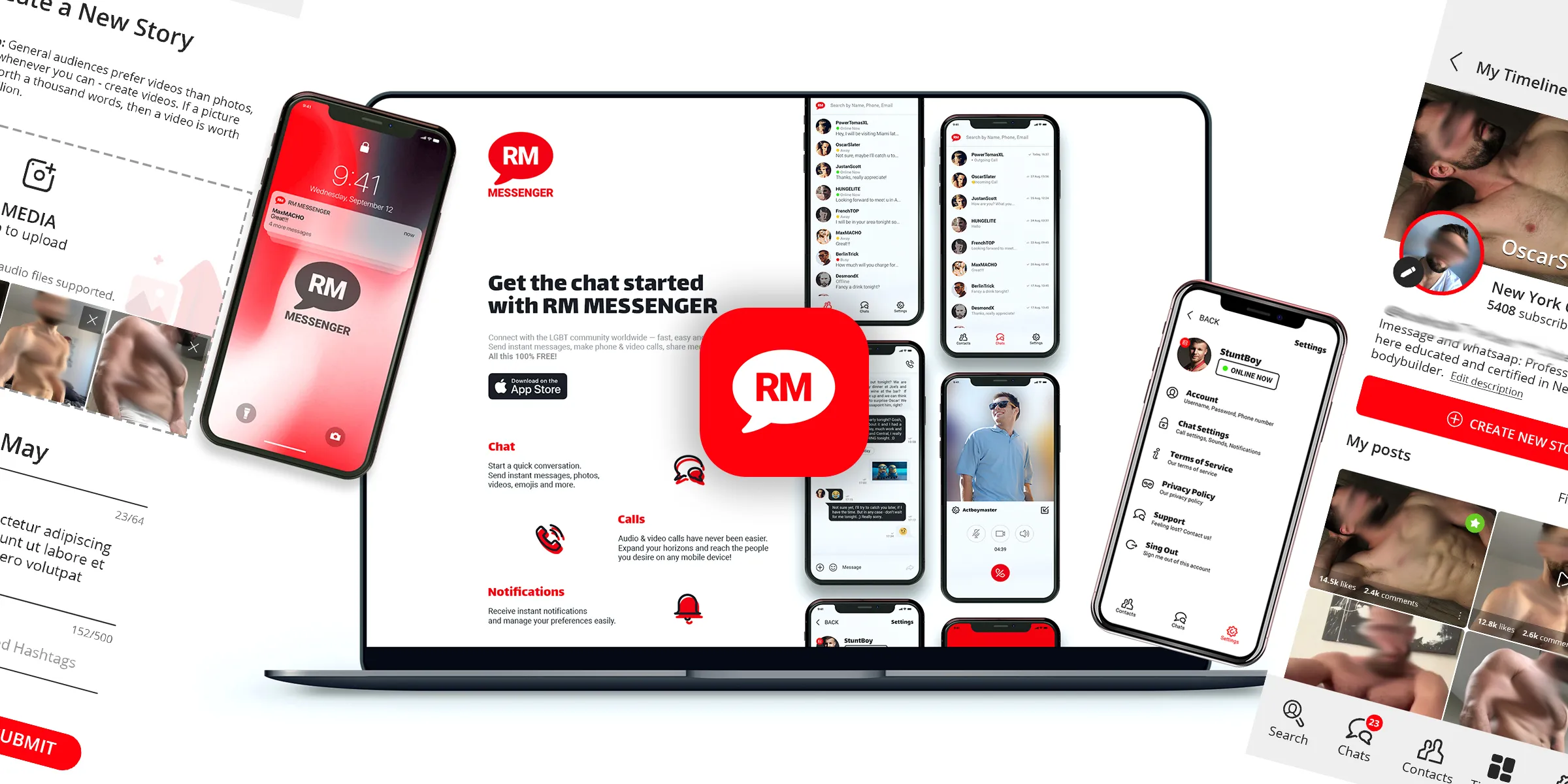
RM Landing Page
Browse · Web Design
Software · Figma · Photoshop · Illustrator · VS Code.
Technologies · Landing Page · HTML · CSS · SaaS · Scroll Animation · Web Design · UX/UI Design · Responsive Web Design.
